The Amazon’s Choice badge isn’t awarded randomly—and it’s not driven by sales alone.
Amazon evaluates keyword relevance, Prime fulfillment, pricing strength, customer ratings, inventory reliability, and conversion performance before assigning the badge.
This guide explains how those signals work, how to align your product for Amazon’s algorithm, and how Amerify helps sellers build Amazon’s Choice eligibility into every product launch.
How Amazon’s Choice Actually Works? (What Most Sellers Get Wrong?
Most sellers chasing the Amazon’s Choice badge already know what it looks like—but many misunderstand how it’s awarded.
The Amazon’s Choice badge is keyword-specific, not product or category-wide. A product may earn the badge for one search term but not appear as Amazon’s Choice for closely related keywords.
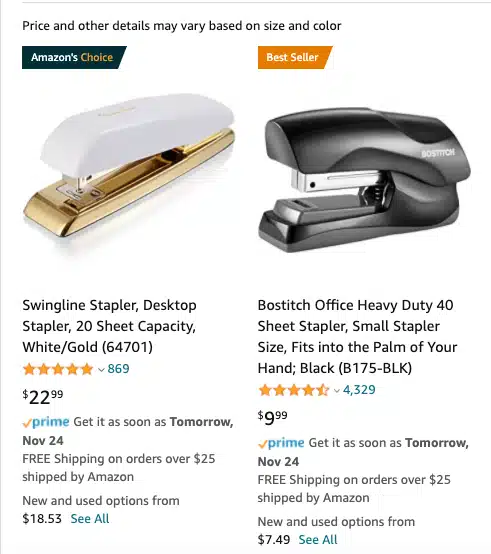
Unlike the Best Seller badge, which is driven largely by overall category sales, Amazon’s Choice is influenced by search-term relevance combined with customer experience signals, such as Prime eligibility, ratings, pricing, and conversion performance.
Just as important: Amazon’s Choice is fully automated.
- There is no application process
- Sellers cannot request or enable it manually
- Amazon Seller Support cannot assign or restore the badge
The badge is controlled entirely by Amazon’s algorithm and can appear—or disappear—based on ongoing performance.
Strategic steps: How to become Amazon’s Choice?
Earning Amazon’s Choice is not about a single tactic.
It’s the result of aligning keyword relevance, customer experience, operational reliability, and sales performance around one specific search term. Here’s how that works in practice.
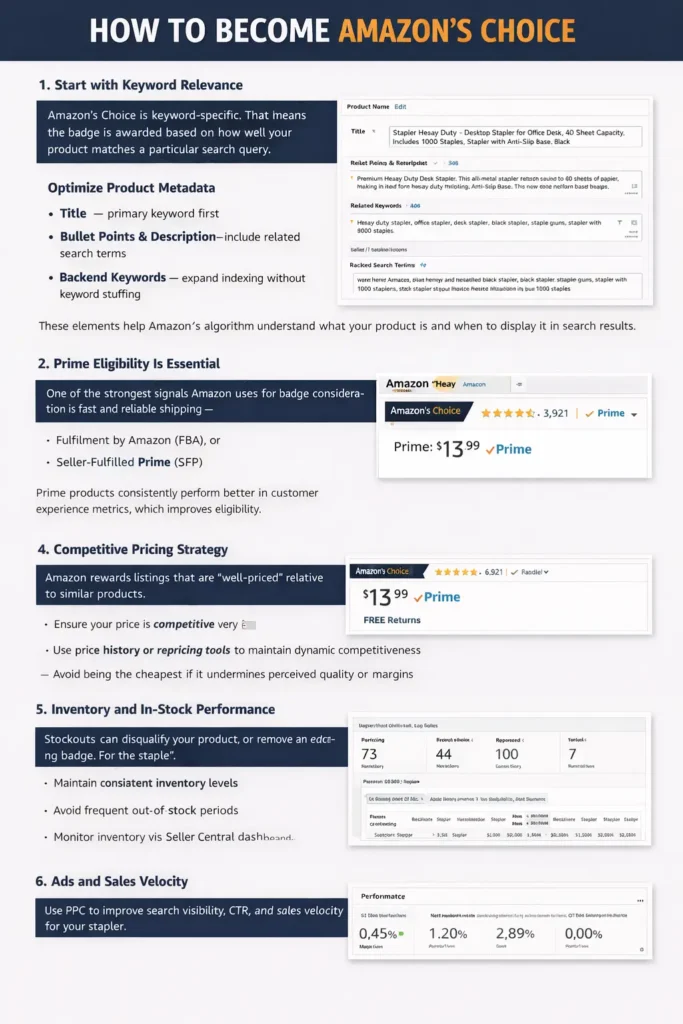
1. Start with Keyword Relevance
Amazon’s Choice is not category-wide. It is awarded per keyword, which means your stapler could earn the badge for “heavy-duty desk stapler” but not for “office stapler”.
Amazon’s algorithm looks for the product that best satisfies the shopper’s intent for a specific search query.
Optimize Product Metadata for Precision
Your listing must clearly communicate relevance at every level:
- Title
Place the primary keyword early and keep it readable:
“Heavy Duty Desk Stapler – Metal Office Stapler for 50 Sheets” - Bullet Points & Description
Reinforce relevance using secondary keywords while focusing on benefits:- Sheet capacity
- Durability
- Office or professional use
- Jam-free mechanism
Avoid repetition for its own sake—Amazon rewards clarity, not keyword stuffing.
- Backend Search Terms
Use Seller Central’s backend keyword fields to capture:- Misspellings
- Synonyms
- Long-tail phrases
These don’t show to shoppers but help Amazon understand when to surface your product.
2. Prime Eligibility Is Essential
Fast, reliable shipping is one of the strongest signals behind Amazon’s Choice.
Most products earning the badge are:
- Fulfilled by Amazon (FBA), or
- Seller-Fulfilled Prime (SFP)
Prime eligibility improves:
- Delivery speed
- Customer trust
- Conversion rates
- Buy Box performance
From Amazon’s perspective, Prime products reduce friction and complaints—making them safer recommendations for shoppers.
If your stapler is not Prime-eligible, your chances of earning Amazon’s Choice drop significantly.
3. Maintain High Ratings & Review Volume
Amazon favors products that shoppers consistently like and trust.
For Amazon’s Choice eligibility, your stapler should aim for:
- 4.0 stars or higher
- A steady flow of recent, verified reviews
- Minimal spikes in negative feedback
What Matters More Than Perfection?
Amazon doesn’t require flawless reviews—but it does look for:
- Consistency
- Recent activity
- Authentic engagement
A product with 4.3 stars and steady new reviews often outperforms a stagnant 5-star listing with low volume.
Pro tip:
Address common complaints (packaging, durability, jams) directly in your listing to reduce future negative reviews.
4. Competitive Pricing Strategy
Amazon’s Choice favors products that are well-priced for their value, not simply the cheapest.
For your stapler:
- Stay within the competitive price range for similar products
- Monitor competitor pricing regularly
- Use repricing or price-tracking tools to remain dynamic
Avoid aggressive underpricing that:
- Hurts margins
- Signals low quality
- Leads to higher return rates
Why does pricing matter?
Better pricing improves conversion rate and sales velocity—two signals Amazon heavily weighs when assigning the badge.
5. Inventory and In-Stock Performance
Even strong listings lose Amazon’s Choice eligibility if inventory management fails.
To stay competitive:
- Maintain consistent stock levels
- Avoid frequent or extended stockouts
- Monitor inventory health in Seller Central
Stockouts interrupt:
- Sales momentum
- Keyword ranking
- Conversion history
When inventory drops to zero, Amazon often shifts visibility—and the badge—to a competitor.
Operational stability matters as much as marketing performance.
6. Ads and Sales Velocity
While advertising does not directly award Amazon’s Choice, it accelerates the signals Amazon tracks.
For your stapler:
- Run Sponsored Products campaigns targeting your primary keyword
- Focus on improving click-through rate (CTR)
- Drive consistent, keyword-specific sales
Ads help:
- Establish keyword relevance faster
- Increase data signals for conversion
- Support organic ranking growth
Important note:
Ads amplify strong listings—they cannot compensate for poor pricing, reviews, or fulfillment.
7. Performance Metrics That Drive Eligibility
Behind the scenes, Amazon evaluates multiple performance indicators tied to buyer satisfaction.
Key metrics include:
- Conversion rate for the target keyword
- Order volume and consistency
- Return rate
- Complaint frequency
- Order defect rate
- Delivery performance
Products that combine:
- Strong relevance
- Reliable fulfillment
- Positive customer outcomes
are far more likely to earn—and keep—Amazon’s Choice. Amazon’s Choice is not a badge you apply for—it’s a result you engineer.
When keyword alignment, pricing, Prime fulfillment, customer satisfaction, and operational discipline work together, Amazon naturally identifies your product as the safest recommendation for shoppers.
That’s the real path to earning—and sustaining—Amazon’s Choice.
Amazon’s Choice Badge vs Best Seller Badge
Many sellers confuse Amazon’s Choice with the Best Seller badge, but they serve very different purposes.
Amazon’s Choice is awarded based on keyword relevance and performance signals.
- It highlights products that are most likely to satisfy a specific search query, taking into account Prime eligibility, customer ratings, sales velocity, and inventory consistency.
- This means a product may have the Amazon’s Choice badge for one keyword but not for others.
In contrast, the Best Seller badge is primarily based on overall sales in a category, rather than keyword targeting or search relevance.
A best-selling product may have high volume and popularity, but might not necessarily be the best choice for a particular search term.
Understanding this distinction helps sellers focus their strategy.
To earn Amazon’s Choice, you need to optimize listings, keywords, pricing, and performance metrics in alignment with specific search terms, whereas Best Seller status depends more on achieving high overall sales.
| Feature | Amazon’s Choice | Best Seller |
| Award Basis | Keyword relevance, performance signals | Sales volume vs. other products in the category |
| Prime Eligibility | Strong factor | Not required |
| Customer Ratings | Important | Less crucial |
| Sales Focus | Within the specific search term performance | Overall sales rank |
How Long Does It Take to Get Amazon’s Choice?
There is no fixed timeline for earning the Amazon’s Choice badge. In most cases, it can take anywhere from a few days to several weeks, depending on competition and performance signals.
Products tend to earn the badge faster when:
- The target keyword has moderate or low competition
- The product is Prime-eligible from launch
- Conversion rate and sales velocity improve quickly
- Pricing aligns well with competing listings
- Early reviews begin coming in steadily
In highly competitive categories, the process may take longer because Amazon compares your performance against many strong alternatives. It’s also common for the badge to appear temporarily and then stabilize as Amazon gathers more data.
This is why consistency matters more than speed. Amazon’s Choice rewards sustained performance, not short-term spikes.
New Products as Amazon’s Choice
New products can earn Amazon’s Choice, but only under specific conditions.
Amazon may award the badge to a new listing when:
- The product targets a low-competition or long-tail keyword
- Prime eligibility is enabled immediately
- Sponsored Products ads drive early keyword-specific sales
- Conversion rate is strong from the beginning
- Pricing is competitive within the niche
For new launches, Amazon’s Choice often appears temporarily as Amazon tests shopper response. If performance remains strong, the badge can stabilize. If not, it may rotate to another product.
This makes the launch strategy critical. Sellers who optimize listings, fulfillment, pricing, and ads from day one give Amazon clearer signals — and improve their chances significantly.
Common Mistakes That Hurt Amazon’s Choice Chances
Even good products can miss out on the badge when sellers neglect key signals:
- Ignoring keyword optimization
- Letting inventory run out
- Overpricing relative to competitors
- Poor customer service response times
- Weak PPC or no visibility strategy
Avoiding these common errors keeps your product competitive and increases your badge eligibility over time.
What Happens After You Earn the Badge?
It’s important to understand that:
- The badge can appear or disappear based on ongoing performance.
- It may only show for some search terms but not all.
- There’s no formal application; Amazon awards it automatically.
This reinforces the need for consistent optimization and monitoring, not one-time fixes.
Remember Amazon’s Choice does not directly boost organic rankings. Instead, it influences shopper behavior, which then affects ranking indirectly.
Here’s how it works:
- The badge increases click-through rate (CTR)
- Higher CTR improves conversion rate
- Better conversion strengthens keyword-level performance
- Strong keyword performance improves organic ranking over time
Becoming Amazon’s Choice requires ongoing optimization across SEO, pricing, fulfillment, and performance metrics. For many sellers, this is a multi-disciplinary challenge.
Amerify specializes in:
- Product launch strategies
- Keyword and listing optimization
- Performance analytics and operational alignment
- Long-term visibility and growth strategies
If your product hasn’t yet achieved the badge or is struggling to maintain rankings, expert help can accelerate your progress.
Contact Amerify for a personalized strategy to help your product qualify for Amazon’s Choice — and scale faster on the Amazon marketplace.